
Undersizing a pool heater is one of the most expensive mistakes in pool construction. This guide walks you through the exact BTU formula used by commercial pool engineers — plus quick sizing tables for residential pools — so you can select the right heater the first time.
Choosing the wrong BTU rating for a pool heater is one of the most common — and costly — mistakes in pool equipment specification. An undersized heater runs constantly and never reaches target temperature. An oversized heater short-cycles, stresses the heat exchanger, and burns through gas unnecessarily. This guide gives you the exact formula that commercial pool engineers use, plus simplified tables for residential applications, so you can specify the correct heater the first time.
The BTU Formula: How Pool Heaters Are Sized
Pool heater BTU requirements are determined by two factors: the volume of water you need to heat, and the rate of heat loss from your pool surface. Heat loss is always the dominant factor — a larger pool in a warm, calm environment may need fewer BTUs than a smaller pool in a cold, windy location.
BTU Required = Pool Surface Area (sq ft) × Temperature Rise (°F) × 12 BTU This formula calculates the BTUs needed to raise temperature 1°F per hour. Multiply by your required temperature rise to get your heater's minimum BTU output.
Step 1 — Calculate Pool Surface Area
For a rectangular pool: Length × Width = Surface Area. For freeform or kidney shapes, calculate the approximate area using length × width × 0.85 as a correction factor for irregular shapes.
Step 2 — Determine Required Temperature Rise
Temperature rise = Your desired pool temperature minus the coldest average air temperature when you want to swim. In Nashville TN, average April low is 47°F. If you want the pool at 82°F, your rise is 35°F. In Los Angeles, the April average low is 57°F — your rise would be only 25°F, meaning you need fewer BTUs.
Step 3 — Apply the Formula
Multiply: Surface Area × Temperature Rise × 12 BTU = Minimum BTU/hour output required. Then add 20–25% for heat loss (wind, evaporation, and conduction through pool walls) and another 10% safety margin for commercial pools with high bather loads.
Quick Sizing Tables — Residential Pools
| Pool Size | Approx Surface Area | Mild Climate (15°F rise) | Moderate Climate (25°F rise) | Cold Climate (35°F rise) |
|---|---|---|---|---|
| 12×24 ft | 288 sq ft | 52,000 BTU | 86,400 BTU | 121,000 BTU |
| 16×32 ft | 512 sq ft | 92,000 BTU | 154,000 BTU | 215,000 BTU |
| 20×40 ft | 800 sq ft | 144,000 BTU | 240,000 BTU | 336,000 BTU |
| 18×36 ft | 648 sq ft | 117,000 BTU | 194,000 BTU | 272,000 BTU |
| 25×50 ft | 1,250 sq ft | 225,000 BTU | 375,000 BTU | 525,000 BTU |
For most residential pools in US Southern states: a 300,000 BTU heater covers up to 25,000 gallons comfortably. For pools over 25,000 gallons, or in Northern states, step up to 400,000 BTU. The next step up is commercial-grade units starting at 500,000 BTU.
Quick Sizing Tables — Commercial Pools
Commercial pools have additional heat loss from higher bather loads, mandated ventilation in indoor facilities, and stricter turnover requirements. Apply a 25–40% upsize factor on top of the base formula result.
| Pool Volume | Pool Type | Recommended Minimum BTU | Recommended Model |
|---|---|---|---|
| 10,000–20,000 gal | Residential/Small HOA | 300,000 BTU | Pentair MasterTemp 300, Hayward H300FDN |
| 20,000–50,000 gal | HOA / Small Commercial | 400,000 BTU | Pentair MasterTemp 400, Hayward H400FDN, Jandy JXi 400 |
| 50,000–100,000 gal | Commercial / Municipal | 500,000–750,000 BTU | Raypak 750, Pentair MasterTemp 460, or dual-heater setup |
| 100,000+ gal | Large Commercial / Aquatic Center | 1,000,000+ BTU | Multiple heater manifold — consult engineer |
Gas vs Propane vs Heat Pump: Which Is Right?
Once you know your BTU requirement, you need to choose the fuel source. Each has a different cost profile and application fit.
| Fuel Type | Upfront Cost | Operating Cost | Heat-Up Speed | Best For |
|---|---|---|---|---|
| Natural Gas | $$ | Low–Medium | Fast (1–3 hrs) | Pools on gas line, year-round heating, commercial |
| Propane | $$ | Higher | Fast (1–3 hrs) | Rural locations without natural gas access |
| Electric Heat Pump | $$$ | Lowest | Slow (8–24 hrs) | Warm climates (air temp >50°F), low gas cost areas |
| Solar + Backup Gas | $$$$ | Very Low | Slow + Fast backup | Sun-belt states, sustainability goals |
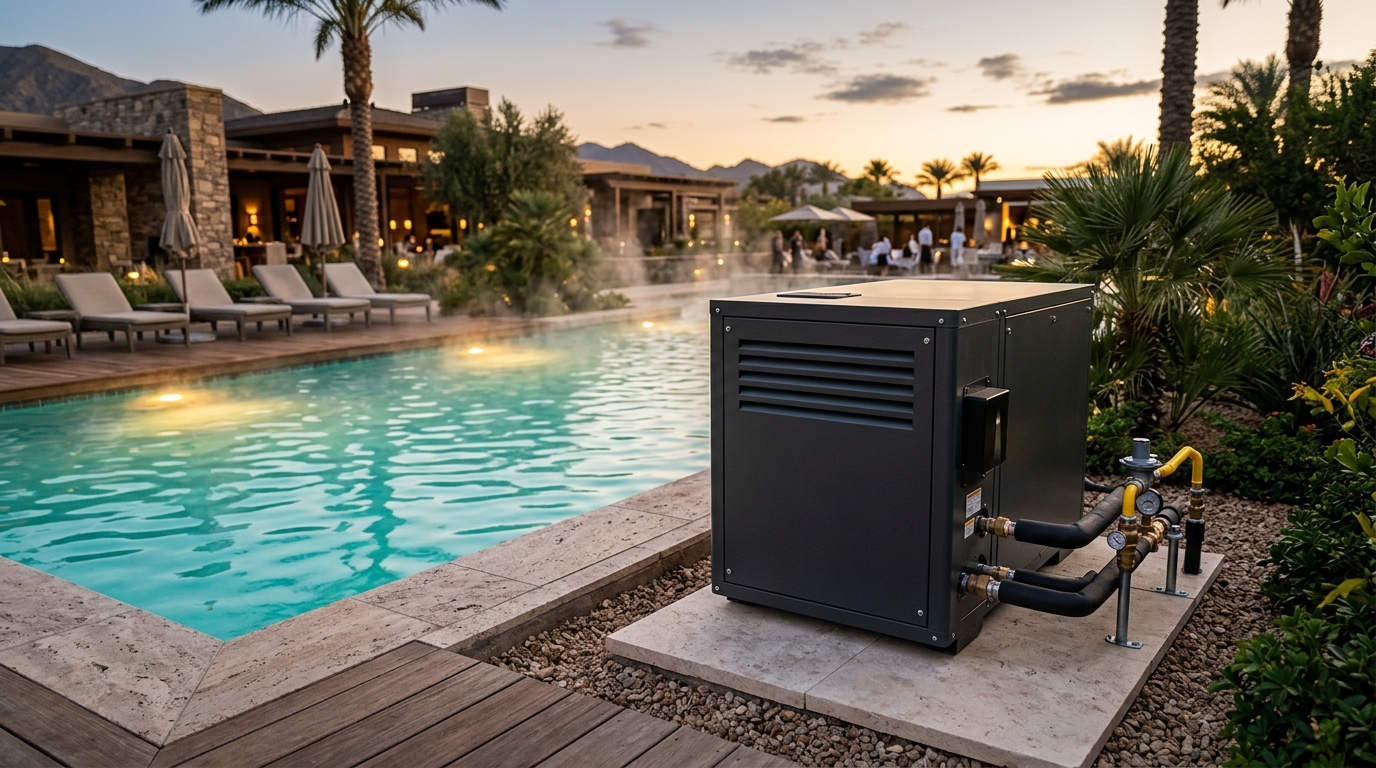
Electric heat pumps extract heat from the ambient air. When air temperature drops below 50°F, efficiency drops dramatically — below 45°F they struggle to heat the pool at all. For any pool that needs heating in cool or cold months, a gas heater (natural gas or propane) is the correct choice. Heat pumps are ideal as primary heaters only in Florida, Southern California, Texas, Arizona, and similar climates.
Top Commercial Pool Heaters: Specs & Prices
| Model | BTU Output | Fuel | Efficiency (AFUE) | Warranty | Typical Wholesale Price |
|---|---|---|---|---|---|
| Pentair MasterTemp 400 | 400,000 BTU | Nat. Gas / Propane | 84% | 3 years | $1,200–$1,500 |
| Hayward H400FDN | 400,000 BTU | Natural Gas | 84% | 3 years | $1,100–$1,400 |
| Jandy JXi 400 | 400,000 BTU | Nat. Gas / Propane | 84% | 3 years | $1,200–$1,500 |
| Raypak 406A | 399,000 BTU | Natural Gas | 82% | 3 years | $1,100–$1,300 |
| Pentair MasterTemp 460 | 460,000 BTU | Nat. Gas / Propane | 84% | 3 years | $1,400–$1,700 |
Where to Buy Pool Heaters at Wholesale Pricing
Pool Supply Wholesalers carries the complete lines of Pentair MasterTemp, Hayward H-Series, Jandy JXi, and Raypak pool heaters at direct wholesale to retail pricing. All models ship same-day from our Nashville TN, Los Angeles CA, Dallas TX, and Orlando FL distribution hubs. No membership required — our wholesale pricing is available to contractors, facility managers, and homeowners alike.
Frequently Asked Questions
How many BTU do I need for a 20,000 gallon pool?
For a 20,000 gallon pool, a 300,000–400,000 BTU heater is typically appropriate for most US climates. In Southern states with mild winters, 300,000 BTU is sufficient. For Northern states or year-round commercial use, step up to 400,000 BTU. Use the surface area formula (Surface Area × Temperature Rise × 12 BTU) for a more precise calculation based on your specific location and desired temperature rise.
What size pool heater do I need for a 30,000 gallon pool?
A 30,000 gallon pool typically requires a 400,000 BTU heater in moderate climates (Southeast, Southwest US). For Northern states or outdoor commercial pools exposed to wind, size up to 500,000 BTU. The pool's surface area matters more than volume for sizing — a shallow 30,000 gallon pool loses heat faster than a deep pool of the same volume.
Is a 400,000 BTU heater enough for a commercial pool?
A 400,000 BTU heater is sufficient for most commercial pools up to approximately 50,000 gallons in moderate climates. Larger commercial pools (50,000–100,000+ gallons), indoor aquatic facilities, and pools in cold climates typically require 500,000 BTU or higher output, often achieved through multiple heaters plumbed in a manifold configuration.
What is the difference between Pentair MasterTemp 300 and 400?
The primary difference is BTU output: 300,000 vs 400,000 BTU. Both use the same high-efficiency cupro-nickel heat exchanger and digital control board. The 400 heats pools faster and handles larger volumes. For pools over 20,000 gallons, the MasterTemp 400 is recommended. Both models are available in natural gas and LP propane versions.